使用两种均质化方法模拟各向异性弹性刚度
同济大学地下建筑与工程系
2025-03-23
\[ \begin{bmatrix} \mathrm{d}\varepsilon_{xx} \\ \mathrm{d}\varepsilon_{yy} \\ \mathrm{d}\varepsilon_{zz} \\ \mathrm{d}\varepsilon_{xy} \\ \mathrm{d}\varepsilon_{xz} \\ \mathrm{d}\varepsilon_{yz} \end{bmatrix}=\begin{bmatrix} \dfrac{1}{E_h} & -\dfrac{v_{hh}}{E_h} & -\dfrac{v_{vh}}{E_v} & & \\ -\dfrac{v_{hh}}{E_h} & \dfrac{1}{E_h} & -\dfrac{v_{vh}}{E_v} & & & \\ -\dfrac{v_{hv}}{E_h} & -\dfrac{v_{hv}}{E_h} & \dfrac{1}{E_v} & & & \\ & & & \dfrac{1}{G_{hh}} & & \\ & & & & \dfrac{1}{G_{vh}} & \\ & & & & & \dfrac{1}{G_{vh}} \end{bmatrix} \begin{bmatrix} \mathrm{d}\sigma_{xx} \\ \mathrm{d}\sigma_{yy} \\ \mathrm{d}\sigma_{zz} \\ \mathrm{d}\sigma_{xy} \\ \mathrm{d}\sigma_{xz} \\ \mathrm{d}\sigma_{yz} \end{bmatrix} \]
| Equation |
|---|
| Kinematic hypothesis |
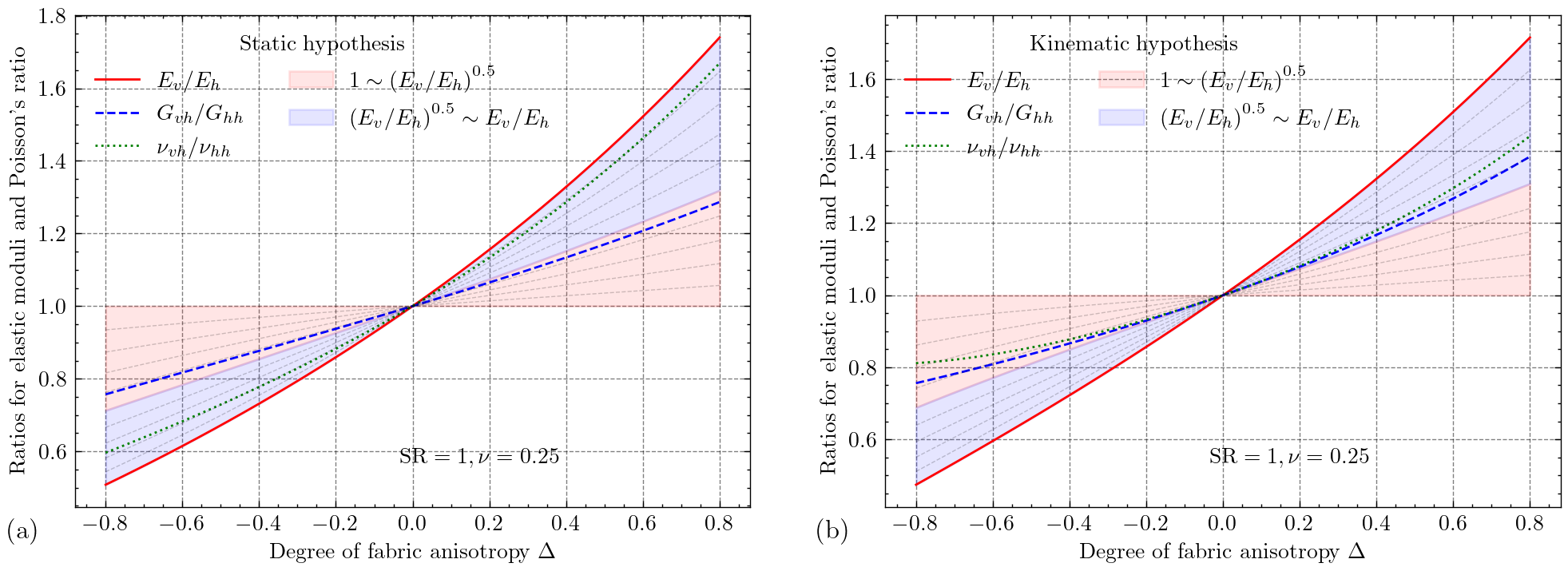
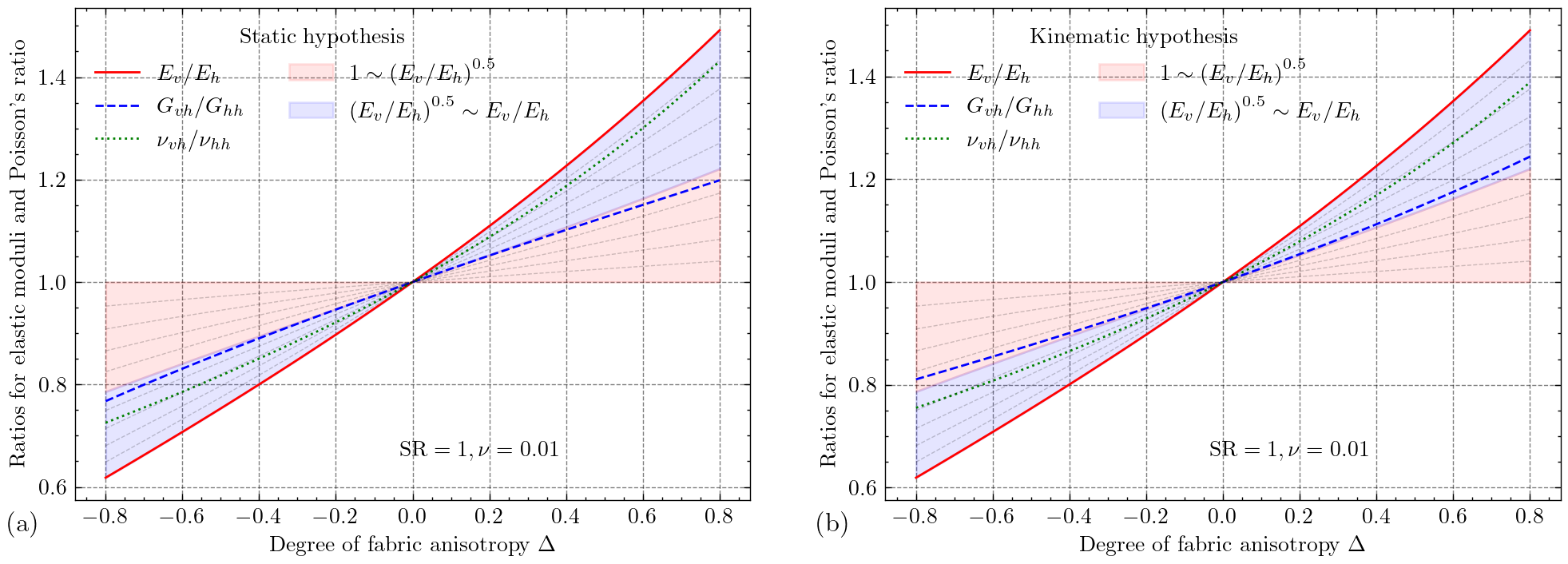
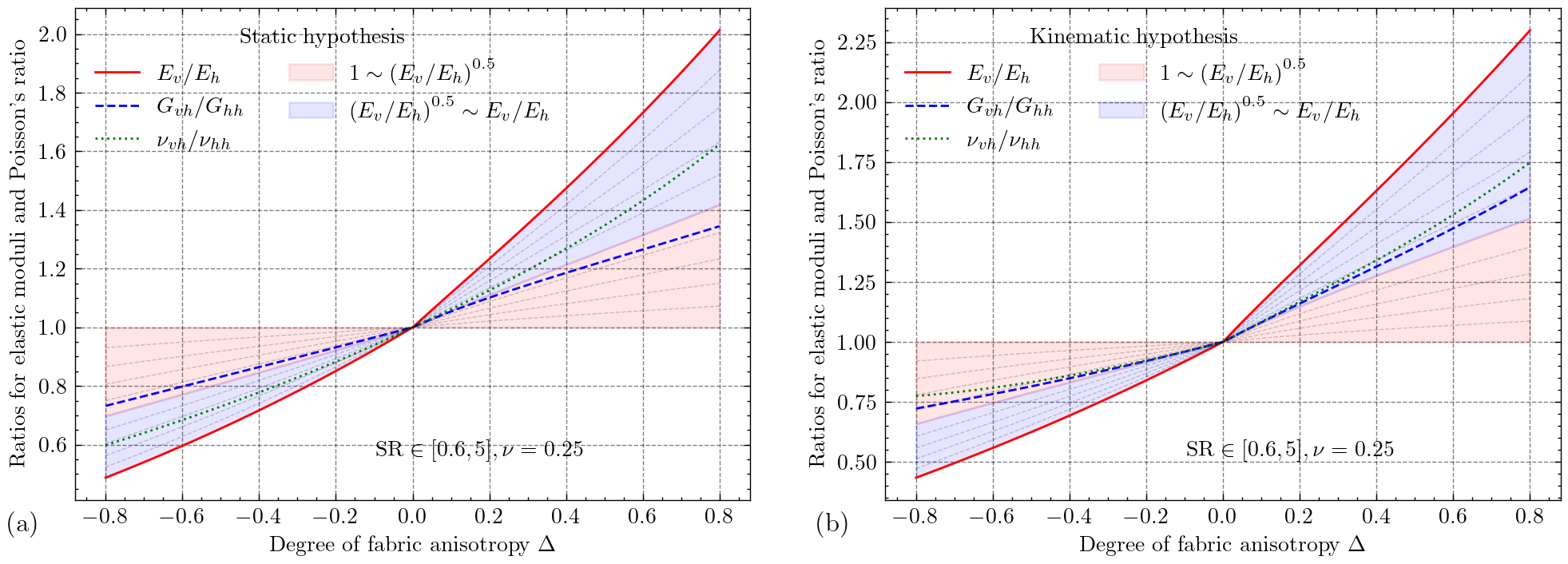
| \(E_v=-\dfrac{E{\left(350\nu -35\Delta+40\Delta\nu +14\Delta^2 \nu +14\Delta^2 -175\right)}}{5{\left(2\nu -1\right)}{\left(7\Delta+12\Delta\nu -35\right)}}\) |
| \(E_h=\dfrac{E{\left(-112\Delta^3 \nu^2 -14\Delta^3 \nu +98\Delta^3 +660\Delta^2 \nu^2 +1050\Delta^2 \nu -735\Delta^2 +24500\nu^2 -24500\nu +6125\right)}}{5{\left(2\nu -1\right)}{\left(33\Delta^2 \nu^2 +56\Delta^2 \nu +98\Delta^2 +420\Delta\nu^2 +175\Delta\nu -245\Delta+2450\nu -1225\right)}}\) |
| \(G_{vh}=G_{hv}=-\dfrac{E{\left(7\Delta-140\nu -8\Delta\nu +70\right)}}{280\nu^2 +140\nu -140},G_{hh}=\dfrac{E{\left(7\Delta+70\nu -8\Delta\nu -35\right)}}{140\nu^2 +70\nu -70}\) |
| \(\nu_{vh}=-\dfrac{5\nu {\left(\Delta+7\right)}}{7\Delta+12\Delta\nu -35},\nu_{hv}=\dfrac{E_h}{E_v}\nu_{vh},\nu_{hh}=1-\dfrac{E_h}{2G_{hh}}\) |
| Static hypothesis |
| \(E_v=\dfrac{7E{\left(2\Delta+5\right)^2}}{5\left(14\Delta-18\Delta\nu +35\right)},E_h=\dfrac{7E{{\left(\Delta-5\right)}}^2 }{5{\left(9\Delta\nu -7\Delta+35\right)}}\) |
| \(G_{vh}=-\dfrac{7E{\left(\Delta+10\right)}}{{\left[{1}\Big/{{\left(\dfrac{\Delta}{5}-1\right)}}-{1}\Big/{{\left(\dfrac{2\Delta}{5}+1\right)}}\right]}{\left(7\Delta+70\nu +\Delta\nu +70\right)}},G_{hh}=-\dfrac{7E{{\left(\Delta-5\right)}}^2 }{10{\left(7\Delta-35\nu +\Delta\nu -35\right)}}\) |
| \(\nu_{vh}=-\dfrac{5\nu {\left(2\Delta+5\right)}{\left(\Delta+7\right)}}{{\left(\Delta-5\right)}{\left(14\Delta-18\Delta\nu +35\right)}},\nu_{hv}=\dfrac{E_h}{E_v}\nu_{vh},\nu_{hh}=1-\dfrac{E_h}{2G_{hh}}\) |
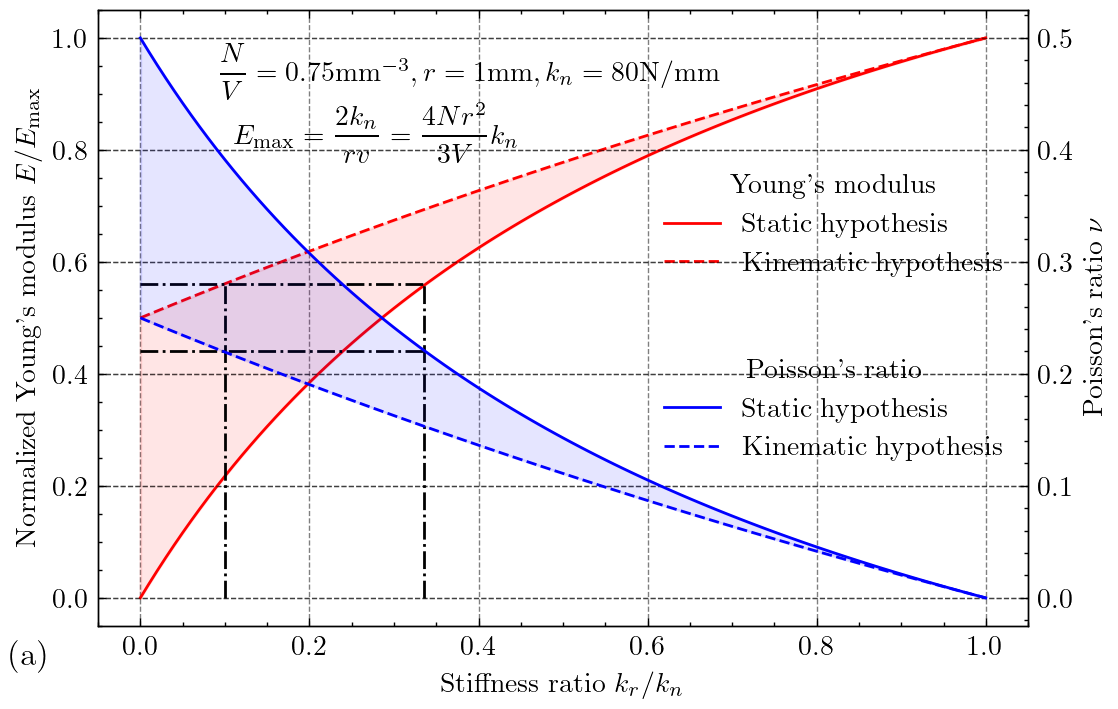
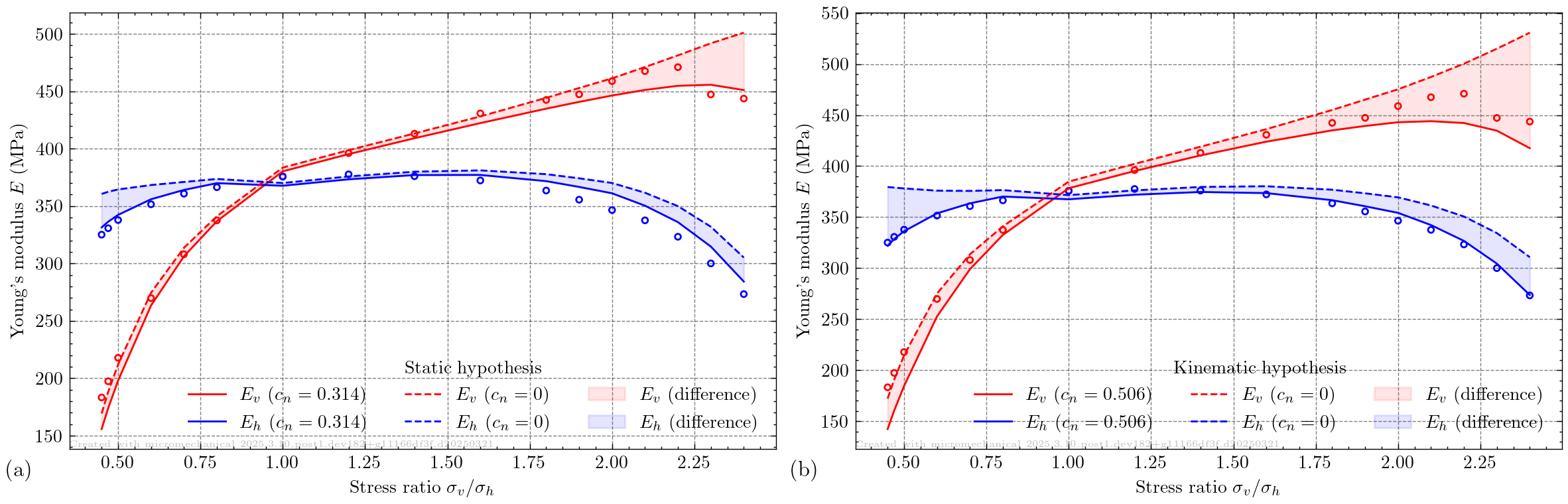
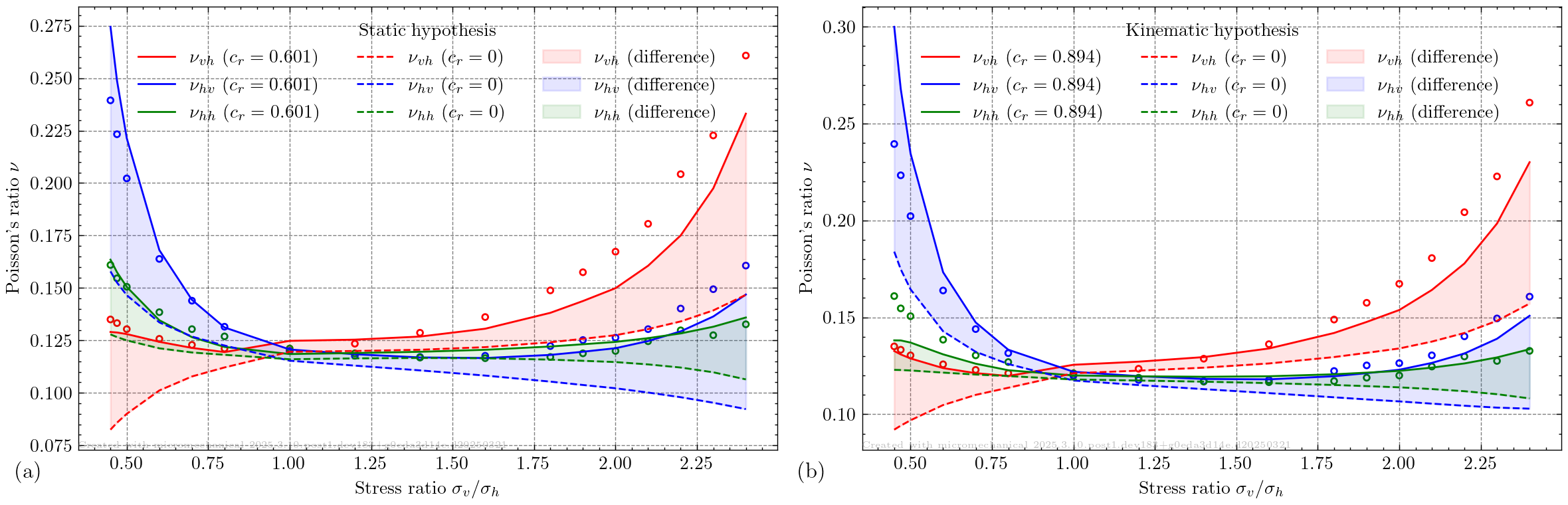
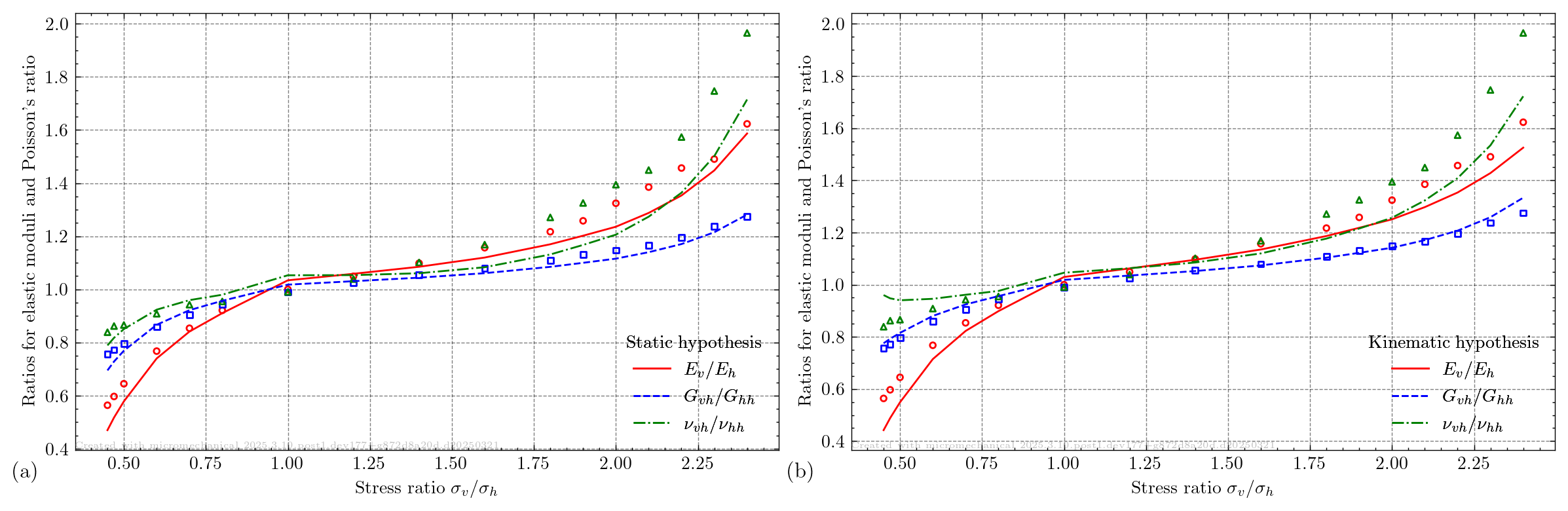
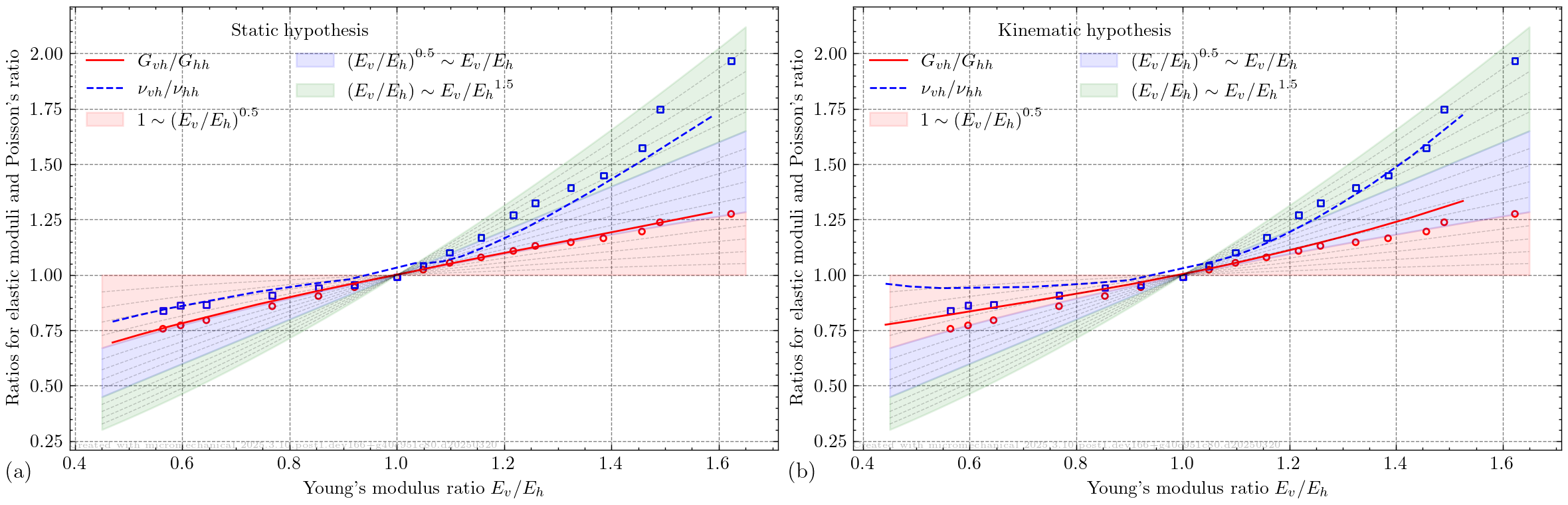
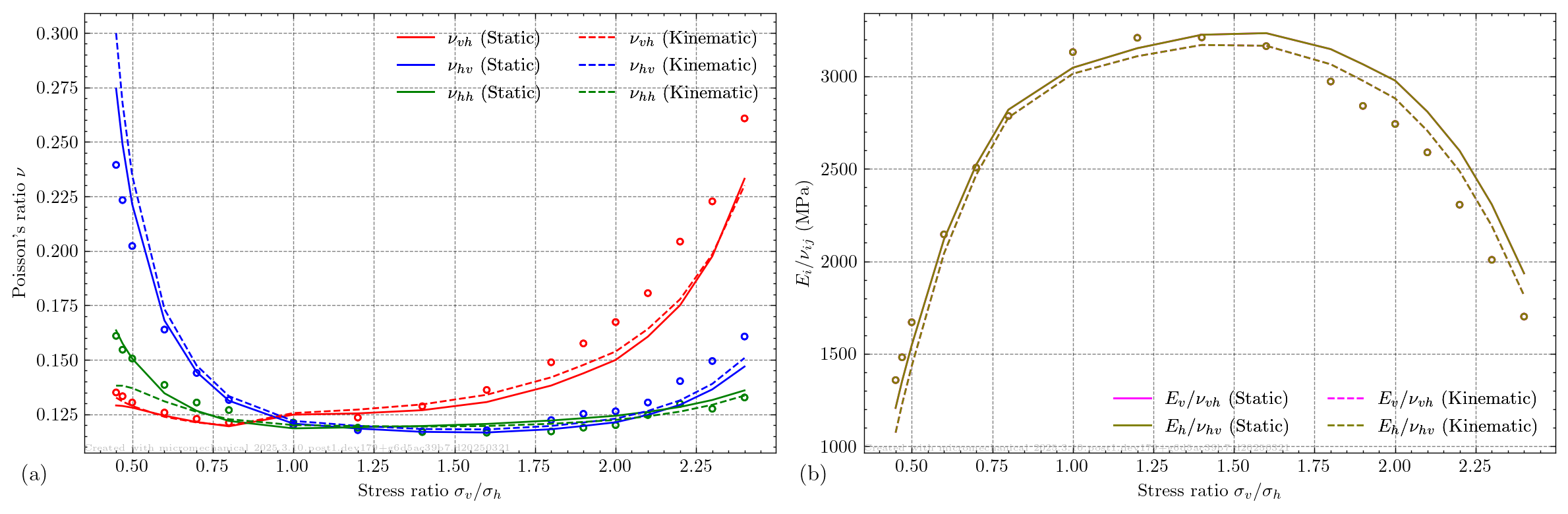
Figure 1: Young’s modulus and Poisson’s ratio between static and kinematic hypotheses
| Hypothesis | \(G_g\) (GPa) | \(\nu_g\) | \(k_{rR}\) | \(n\) | \(n_s\) | \(c_n\) | \(c_r\) |
|---|---|---|---|---|---|---|---|
| Kinematic | 44.9 | 0.2 | 1.221 | 0.348 | 0.423 | 0.506 | 0.894 |
| Static | 47.1 | 0.2 | 0.959 | 0.351 | 0.392 | 0.314 | 0.600 |
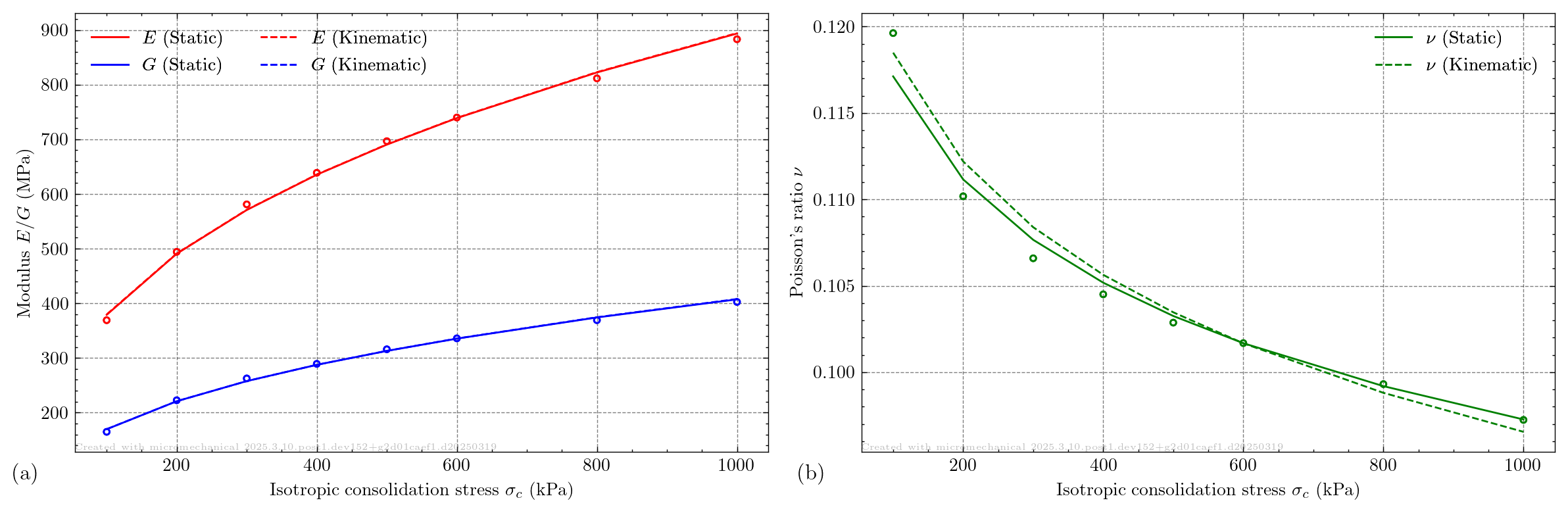
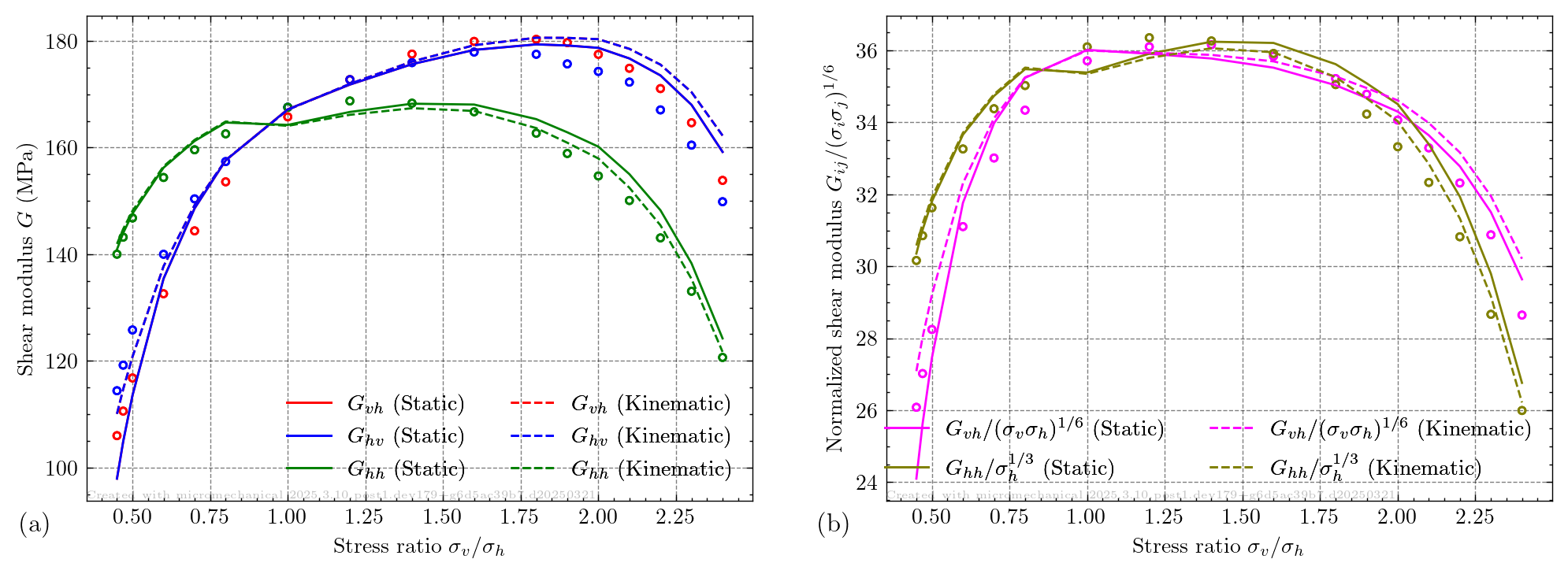
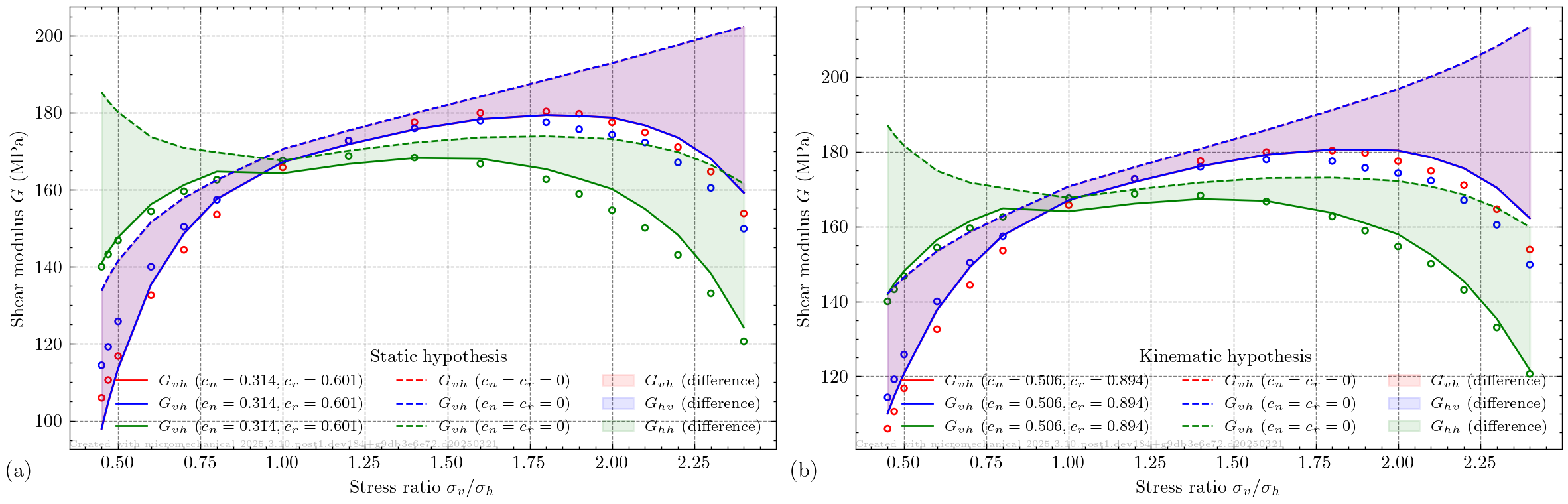
Figure 5: Young’s modulus, shear modulus and Poisson’s ratio at isotropic stress states: (a) Young’s modulus; (b) Poisson’s ratio
引入组构相关的法向刚度 \[ k_n^\prime=k_{n}\left(1-c_n\vert F_i\vert\right) \]
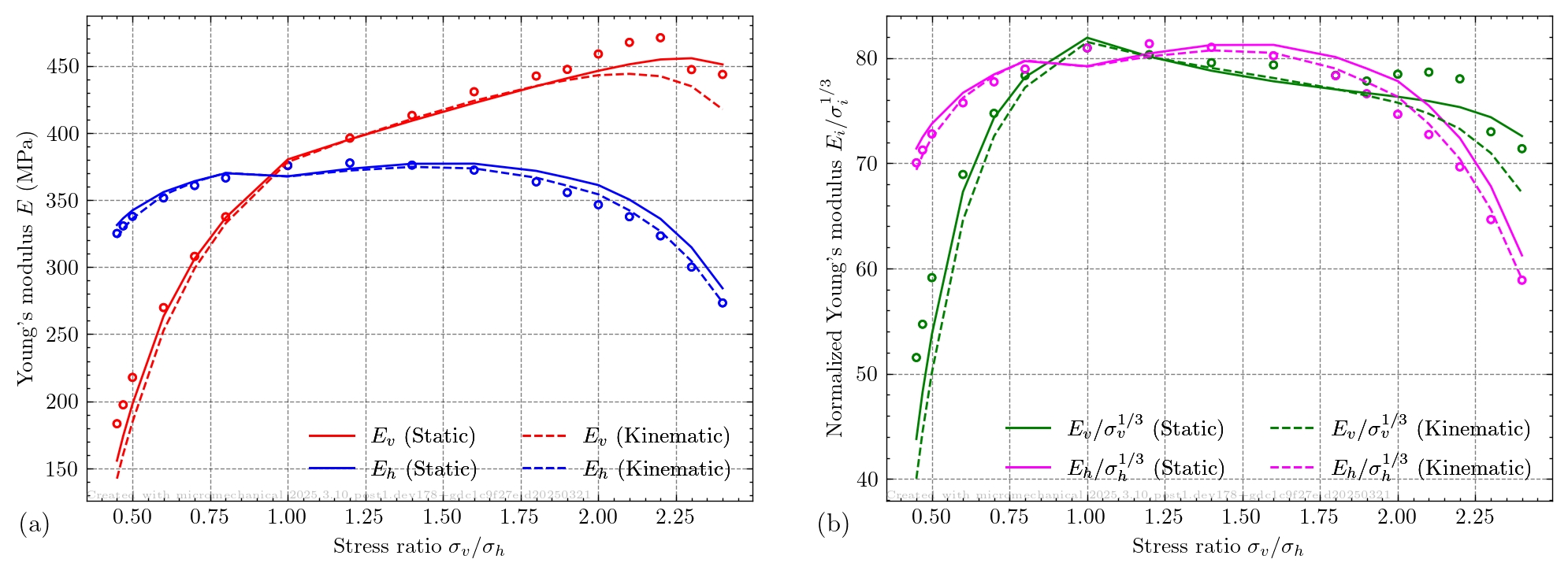
引入组构相关的应力比 \[ \begin{aligned} k_r^\prime&=k_{r}\left(1-c_n\vert F_i\vert\right)\left(1-c_r\sqrt{F_j^2+F_k^2}\right) \\ \dfrac{k_r^\prime}{k_n^\prime}&=\dfrac{k_r}{k_n}\left(1-c_r\sqrt{F_j^2+F_k^2}\right) \end{aligned} \]
同济大学地下建筑与工程系